Short Vowels in Arabic: Fathah, Kasrah, and Dhammah Explained
If you are learning to read Arabic, you have probably noticed small marks placed above and below Arabic letters. These marks may look simple, but they play an essential role in helping you pronounce Arabic words correctly and understand how words function in a sentence.
These marks are called short vowels, or harakat (حَرَكَات).
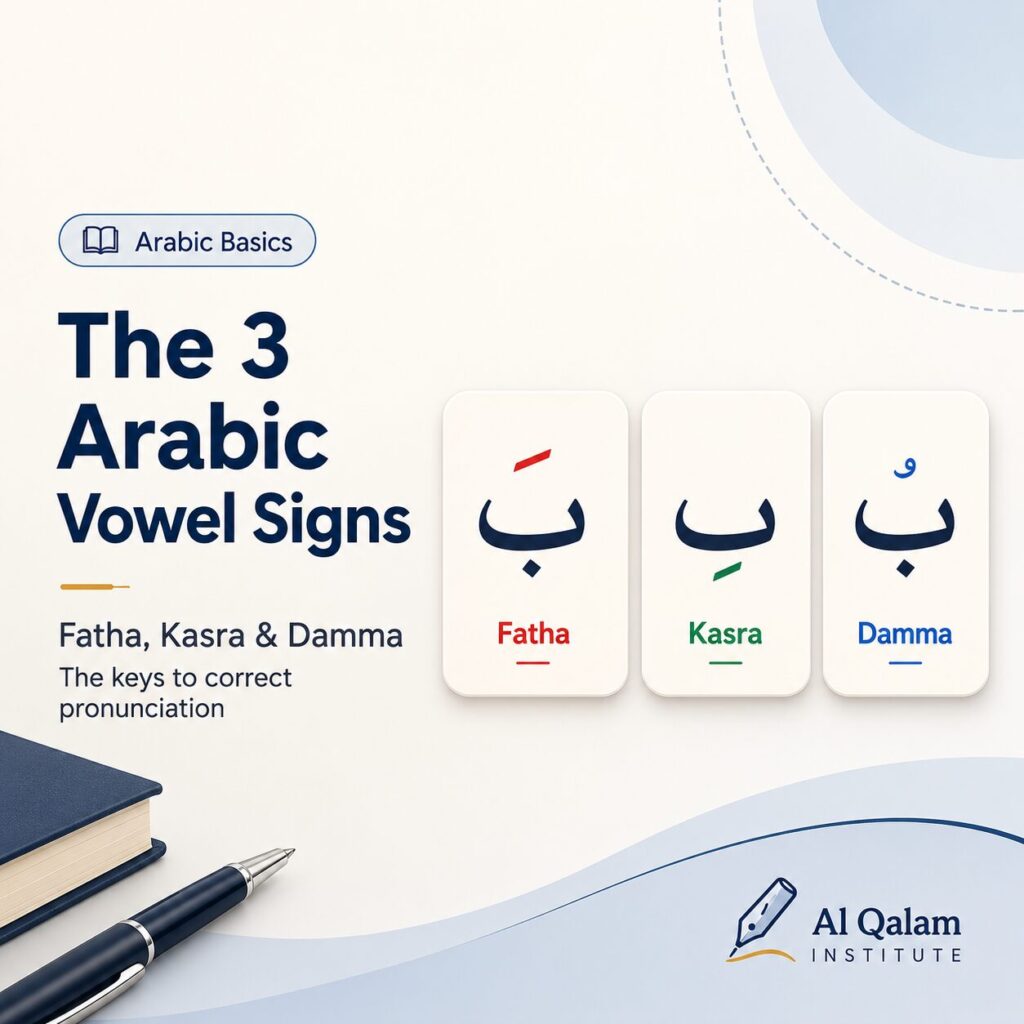
Arabic has three basic short vowels:
- Fathah (فَتْحَة) — َ
- Kasrah (كَسْرَة) — ِ
- Dhammah (ضَمَّة) — ُ
Learning these three vowels is one of the most important first steps for anyone who wants to read Arabic accurately, especially beginners who are also learning to read the Quran.
In this guide, you will learn what Arabic short vowels are, how each one sounds, how they appear in real Arabic words, how they can affect grammar and meaning, and how to practice them effectively.
- Table of Contents
- What Are Short Vowels in Arabic?
- Why Are Arabic Short Vowels Important?
- The Three Short Vowels in Arabic
- Fathah (فَتْحَة)
- Kasrah (كَسْرَة)
- Dhammah (ضَمَّة)
- How Short Vowels Can Change Arabic Words
- What Is Tanwin (تَنْوِين)?
- Short Vowels and Arabic Grammar
- Why Are Short Vowels Important for Reading the Quran?
- Short Vowels in Arabic: Examples
- Practical Exercises
- How to Learn Arabic Short Vowels Effectively
- Frequently Asked Questions
- Conclusion
- What Are Short Vowels in Arabic?
Short vowels in Arabic are small diacritical marks placed around Arabic letters to indicate a short vowel sound.
The three basic short vowels are:
| Short Vowel | Arabic Name | Symbol | Position | Basic Sound |
|---|---|---|---|---|
| Fathah | فَتْحَة | َ | Above the letter | Short “a” |
| Kasrah | كَسْرَة | ِ | Below the letter | Short “i” |
| Dhammah | ضَمَّة | ُ | Above the letter | Short “u” |
For example, take the Arabic letter ب:
- بَ = ba
- بِ = bi
- بُ = bu
The consonant has not changed. The short vowel changes the sound that follows the consonant.
This is why learning Arabic vowels is essential for beginners. Without them, it can be difficult to know exactly how a word should be pronounced.
- Why Are Arabic Short Vowels Important?
Short vowels are important for several reasons.
- 1. They help you pronounce Arabic correctly
When Arabic is fully vowelized, the short vowels tell you how to pronounce each syllable.
For example:
كَتَبَ
is pronounced:
kataba
Without the vowels, it appears as:
كتب
A beginner may not immediately know how to pronounce it.
- 2. They help you distinguish between words
Arabic words can contain the same consonant letters but have different meanings when the vowels change.
For example:
- كَتَبَ — kataba — he wrote
- كِتَاب — kitāb — book
- كُتُب — kutub — books
- كُتِبَ — kutiba — it was written
The consonant letters are related to the same root, but the vowel patterns create different words and grammatical forms.
- 3. They help you understand grammar
In fully vowelized Arabic, the ending of a word can indicate its grammatical role.
For example:
الطَّالِبُ يَقْرَأُ الكِتَابَ.
The student reads the book.
Here:
- الطَّالِبُ has a Dhammah and functions as the subject.
- الكِتَابَ has a Fathah and functions as the object.
This system is known as I‘rab (الإعراب).
- The Three Short Vowels in Arabic
Let’s look at each Arabic short vowel individually.
- 1. Fathah (فَتْحَة)
The Fathah is a small diagonal mark written above the letter:
َ
It generally represents a short “a” sound.
- Fathah with Arabic Letters
| Letter | With Fathah | Pronunciation |
| ب | بَ | ba |
| ك | كَ | ka |
| د | دَ | da |
| س | سَ | sa |
| م | مَ | ma |
Try reading them aloud:
بَ — كَ — دَ — سَ — مَ
The vowel is short. It should not be stretched like a long vowel.
- Fathah in Arabic Words
| Arabic Word | Transliteration | Meaning |
| كَتَبَ | kataba | he wrote |
| ذَهَبَ | dhahaba | he went |
| فَتَحَ | fataḥa | he opened |
| جَلَسَ | jalasa | he sat |
| أَكَلَ | akala | he ate |
Notice how Fathah appears frequently in simple Arabic verbs.
- Practice
Add Fathah to the consonant skeleton:
ك – ت – ب
Answer:
كَتَبَ
Now try:
د – ر – س
Answer:
دَرَسَ
- 2. Kasrah (كَسْرَة)
The Kasrah is a small diagonal mark written below the letter:
ِ
It generally represents a short “i” sound.
Kasrah is easy to recognize because it is the basic short vowel placed below the letter.
- Kasrah with Arabic Letters
| Letter | With Kasrah | Pronunciation |
| ب | بِ | bi |
| ك | كِ | ki |
| ف | فِ | fi |
| ل | لِ | li |
| م | مِ | mi |
Practice:
بِ — كِ — فِ — لِ — مِ
- Kasrah in Arabic Words
| Arabic Word | Transliteration | Meaning |
| كِتَاب | kitāb | book |
| مِفْتَاح | miftāḥ | key |
| بِنْت | bint | girl / daughter |
| فِي | fī | in |
| لِسان | lisān | tongue / language |
One very common Arabic word containing Kasrah is:
فِي
meaning “in” or “at.”
For example:
فِي البَيْتِ
fī al-bayti
“In the house.”
Notice the Kasrah at the end of البَيْتِ.
- 3. Dhammah (ضَمَّة)
The Dhammah is a small rounded mark written above the letter:
ُ
It generally represents a short “u” sound.
- Dhammah with Arabic Letters
| Letter | With Dhammah | Pronunciation |
| ب | بُ | bu |
| ك | كُ | ku |
| ر | رُ | ru |
| س | سُ | su |
| ن | نُ | nu |
Practice:
بُ — كُ — رُ — سُ — نُ
- Dhammah in Arabic Words
| Arabic Word | Transliteration | Meaning |
| مُعَلِّم | muʿallim | teacher |
| مُسَافِر | musāfir | traveler |
| كُتُب | kutub | books |
| مُدِير | mudīr | manager |
| نُور | nūr | light |
Dhammah appears in many Arabic word patterns and is also important in Arabic grammar.
- How Do Short Vowels Change Arabic Words?
One of the most interesting things about Arabic is that changing the vowels can change the pronunciation, meaning, or grammatical function of a word.
Consider the root:
ك – ت – ب
This root is connected with writing.
Now look at these words:
| Arabic | Transliteration | Meaning |
| كَتَبَ | kataba | he wrote |
| كِتَاب | kitāb | book |
| كُتُب | kutub | books |
| كُتِبَ | kutiba | it was written |
The consonant structure is closely related, but the vowel patterns produce different forms.
This is one reason why Arabic learners should not think of vowels as optional decoration. They are an important part of understanding how Arabic words are pronounced and structured.
- What Is Tanwin (تَنْوِين)?
Once you understand the three short vowels, the next useful concept is Tanwin.
Tanwin is the doubling of a short-vowel mark at the end of certain indefinite nouns.
The three main forms are:
| Type | Symbol | Sound | Example |
| Tanwin Fath | ً | -an | كِتَابًا |
| Tanwin Kasr | ٍ | -in | كِتَابٍ |
| Tanwin Damm | ٌ | -un | كِتَابٌ |
For example:
كِتَابٌ
means:
a book
While:
الكِتَابُ
means:
the book
Tanwin is therefore closely connected to Arabic grammar and definiteness.
- Short Vowels and Arabic Grammar
Arabic short vowels are not only about pronunciation.
In fully vowelized Arabic, word endings can provide important grammatical information.
Consider:
الطَّالِبُ يَقْرَأُ الكِتَابَ.
“The student reads the book.”
The word:
الطَّالِبُ
has a Dhammah at the end and functions as the subject.
The word:
الكِتَابَ
has a Fathah at the end and functions as the object.
Now compare:
صَفَحَاتُ الكِتَابِ جَمِيلَةٌ.
“The pages of the book are beautiful.”
Here:
الكِتَابِ
has a Kasrah because it is in a genitive relationship with صَفَحَاتُ.
These endings are part of the Arabic grammatical system known as I‘rab (الإعراب).
For beginners, you do not need to master all of Arabic grammar immediately. However, becoming familiar with the three short vowels gives you a strong foundation for understanding it later.
- Why Are Short Vowels Important for Reading the Quran?
For students learning Arabic in order to read the Quran, short vowels are especially important.
The Quran is written with detailed vowel markings and other pronunciation signs that help readers pronounce the words correctly.
Learning Fathah, Kasrah, and Dhammah gives beginners an essential foundation for:
- Recognizing vowel marks while reading.
- Pronouncing Arabic letters correctly.
- Reading Quranic words more confidently.
- Distinguishing different vowel patterns.
- Preparing for more advanced Quran reading and Tajweed study.
For example:
رَبِّ
contains a Kasrah:
رَبِّ
while:
رَبُّ
has a Dhammah.
Recognizing these marks helps students become more comfortable with fully vowelized Quranic text.
However, short vowels are only one part of Quran reading. Students also need to learn letter pronunciation, connected letters, Sukoon, Shaddah, Tanwin, Madd, and the rules of Tajweed as they progress.
This is why a structured learning path is especially helpful for beginners.
- Short Vowels in Arabic: Examples
Here is a simple practice chart combining the three basic short vowels.
| Letter | Fathah | Kasrah | Dhammah |
| ب | بَ — ba | بِ — bi | بُ — bu |
| ك | كَ — ka | كِ — ki | كُ — ku |
| د | دَ — da | دِ — di | دُ — du |
| ف | فَ — fa | فِ — fi | فُ — fu |
| م | مَ — ma | مِ — mi | مُ — mu |
| س | سَ — sa | سِ — si | سُ — su |
| ن | نَ — na | نِ — ni | نُ — nu |
| ر | رَ — ra | رِ — ri | رُ — ru |
| ل | لَ — la | لِ — li | لُ — lu |
| ه | هَ — ha | هِ — hi | هُ — hu |
- How to Practice
Read each row slowly:
بَ — بِ — بُ
Then:
كَ — كِ — كُ
Then:
دَ — دِ — دُ
Repeat each group several times until you can recognize the vowel visually and produce the correct sound automatically.
- Practical Exercises to Master Arabic Short Vowels
Understanding the explanation is only the beginning. You need to practice recognizing and pronouncing the vowels.
- Exercise 1: Identify the Vowel
Look at the following examples and identify the short vowel.
- 1. كَتَبَ
What vowel appears on:
كَ?
تَ?
بَ?
Answer: Fathah
- 2. مُعَلِّمٌ
What vowel appears on the first letter?
Answer: Dhammah
What does ٌ represent?
Answer: Tanwin Damm
- 3. فِي البَيْتِ
What vowel appears under the ف?
Answer: Kasrah
Why does البَيْتِ end with Kasrah?
Because it follows the preposition فِي and is therefore in the genitive case.
- Exercise 2: Add the Correct Vowels
Complete each word based on the English meaning.
| Consonants | Meaning | Answer |
| د – ر – س | He studied | دَرَسَ |
| ك – ت – ب | Books | كُتُب |
| م – د – ر – س – ة | School | مَدْرَسَةٌ |
| ط – ل – ب | Student | طَالِبٌ |
Try covering the answers and solving them yourself.
- Exercise 3: Recognize the Grammatical Role
Read the following sentences:
الطَّالِبُ يَقْرَأُ الكِتَابَ.
“The student reads the book.”
قَرَأَ المُعَلِّمُ الكِتَابَ.
“The teacher read the book.”
صَفَحَاتُ الكِتَابِ جَمِيلَةٌ.
“The pages of the book are beautiful.”
Notice the different endings:
- الطَّالِبُ → Dhammah
- الكِتَابَ → Fathah
- الكِتَابِ → Kasrah
The same noun الكِتَاب can have different endings depending on its grammatical role.
- How to Learn Arabic Short Vowels Effectively
The best way to learn short vowels is not simply to memorize their names.
You should train three skills together:
- 1. Visual Recognition
Train your eyes to recognize:
َ Fathah
ِ Kasrah
ُ Dhammah
- 2. Pronunciation
Say the sound immediately when you see the mark.
For example:
بَ → ba
بِ → bi
بُ → bu
- 3. Reading in Context
Once you recognize the vowels on individual letters, move to complete words and sentences.
For example:
بَ
then:
بَاب
then:
هَذَا بَابٌ.
“This is a door.”
This gradual progression helps learners move from recognizing isolated sounds to reading meaningful Arabic naturally.
At Al Qalam Institute, Arabic learning can be structured around the learner’s level, goals, and reading ability, helping students build their foundation step by step rather than trying to memorize everything at once.
- Frequently Asked Questions About Short Vowels in Arabic
- What are the three short vowels in Arabic?
The three basic short vowels are:
- Fathah (فَتْحَة) — َ — short “a”
- Kasrah (كَسْرَة) — ِ — short “i”
- Dhammah (ضَمَّة) — ُ — short “u”
They are written as small marks around Arabic letters.
- Why are short vowels often missing from Arabic texts?
Arabic texts written for proficient native readers often omit short vowels because experienced readers can usually determine pronunciation from context, vocabulary, and grammar.
However, short vowels are commonly included in:
- The Quran
- Children’s books
- Arabic learning materials
- Beginner reading texts
- Some classical and educational texts
For beginners, fully vowelized texts are especially useful because they provide clear pronunciation guidance.
- Do short vowels change the meaning of Arabic words?
Yes.
Changing the vowel pattern can create a different word, pronunciation, or grammatical form.
For example:
كَتَبَ — he wrote
كِتَاب — book
كُتُب — books
Different vowel patterns produce different forms.
- What is the difference between short and long vowels in Arabic?
Short vowels are represented by diacritical marks:
َ ِ ُ
Long vowels are represented through letters:
- Fathah + ا → long ā
- Kasrah + ي → long ī
- Dhammah + و → long ū
For example:
بَ — ba
بَا — bā
The second sound is longer because it contains a long vowel.
- Are Arabic short vowels important for Quran reading?
Yes.
Understanding short vowels is an important foundation for beginners learning to read the Quran because Quranic text includes vowel markings that guide pronunciation.
However, learners should also study other reading signs and, as they progress, Tajweed rules.
- Can I learn Arabic reading without learning short vowels?
You may recognize some Arabic words through memorization, but learning the short vowels makes accurate reading much easier.
For beginners, learning the vowels early can help prevent incorrect pronunciation habits and make later reading and grammar lessons easier.
- Conclusion
Arabic short vowels may look like tiny marks, but they are fundamental to learning how to read Arabic.
The three basic short vowels are:
Fathah — َ
Kasrah — ِ
Dhammah — ُ
They help learners pronounce Arabic words, recognize different word patterns, understand grammatical relationships, and develop accurate reading skills.
For students learning Arabic to communicate, read classical texts, or understand the Quran, mastering these basic vowel marks is an important early milestone.
The key is consistent practice.
Start with individual letters:
بَ — بِ — بُ
Move to words:
كَتَبَ — كِتَاب — كُتُب
Then progress to complete sentences and fully vowelized texts.
With the right guidance and regular practice, Arabic reading becomes much more predictable, logical, and enjoyable.
- Learn Arabic with Al Qalam Institute
Ready to build a stronger foundation in Arabic?
At Al Qalam Institute, we help non-Arabic speakers develop their Arabic skills through structured, personalized online lessons.
Whether your goal is to:
- Learn Arabic from the beginning
- Improve your Arabic reading
- Learn Quran reading
- Develop your pronunciation
- Study Arabic grammar
- Speak Arabic with greater confidence
- Learn Classical or Modern Arabic
you can follow a learning path designed around your level and goals.
Start your Arabic learning journey with Al Qalam Institute and build your foundation step by step.