Signs of Stopping in the Qur’an: A Complete Guide to Waqf Signs
Reading the Qur’an correctly is not only about pronouncing the Arabic letters and applying Tajweed rules. Understanding where to stop and where to continue is also an important part of proper Qur’an recitation.
When you open a printed Mushaf, you may notice small symbols placed between words or at certain points in the verses. These are known as Waqf signs (علامات الوقف). They help the reader understand where stopping is appropriate, where continuing is better, and where stopping may affect the meaning.
For students learning Qur’an, especially non-Arabic speakers, learning these signs can make recitation easier, more accurate, and more meaningful.
- What Are Waqf Signs in the Qur’an?
The Arabic word Waqf (وَقْف) means stopping or pausing. In Qur’anic recitation, waqf refers to stopping the recitation at a particular place before continuing.
The scholars of Qur’anic recitation studied the relationship between words and meanings and established principles for Waqf and Ibtida’ (الوقف والابتداء) — stopping and beginning the recitation.
Modern printed Mushafs use specific symbols to guide readers. These signs are especially helpful because stopping at the wrong place can sometimes separate words that are closely connected in meaning.
The King Fahd Glorious Qur’an Printing Complex gives particular attention to the presentation and review of Qur’anic text, including the symbols and conventions used in printed Mushafs. Its digital Qur’an resources also include stopping-related signs and information about the conventions used in the Mushaf.
- Why Are Waqf Signs Important?
Waqf signs serve several important purposes during Qur’an recitation.
- 1. They Help Preserve the Meaning
A reader may reach a point where stopping would make the sentence incomplete or could give a misleading impression. Waqf signs help the reader recognize such places.
- 2. They Make Recitation Easier
Instead of having to determine every stopping point independently, the reader can use the signs in the Mushaf as a guide.
- 3. They Help Beginners
Students who are still learning Arabic grammar and Qur’anic vocabulary may find it difficult to recognize relationships between words. Waqf signs provide an additional visual guide.
- 4. They Improve Understanding
Knowing where a statement naturally ends can help the reader follow the meaning of an ayah more clearly.
- The Most Common Waqf Signs in the Mushaf
Different Mushafs and printing traditions may use somewhat different conventions. Therefore, a learner should become familiar with the signs used in the particular Mushaf they are reading.
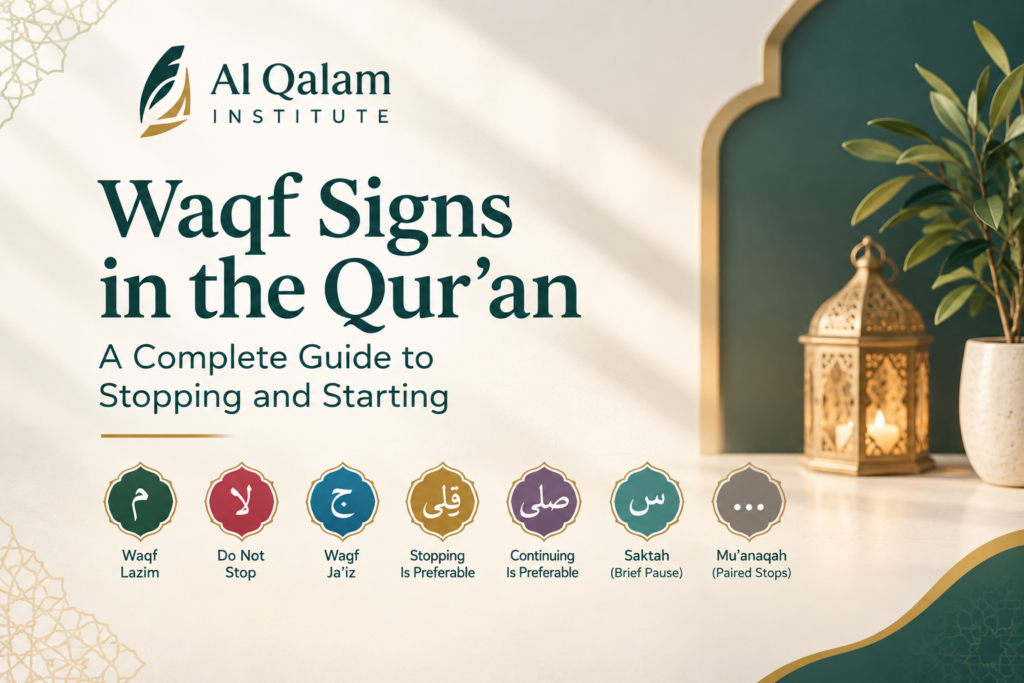
Among the commonly encountered signs are:
| Sign | Common Name | General Meaning |
|---|---|---|
| م | Waqf Lazim | A necessary stop |
| لا | La | Do not stop |
| ج | Waqf Ja’iz | Stopping or continuing is permissible |
| قلى | Qili | Stopping is preferable |
| صلى | Sili | Continuing is preferable |
| س | Saktah | A brief pause without taking a breath |
| ∴ | Mu’anaqah | Stop at one of two related positions, not both |
Let’s look at these signs in more detail.
- 1. The Sign م — Waqf Lazim
The symbol م indicates Waqf Lazim (الوقف اللازم).
It means that stopping at this point is strongly indicated because continuing without stopping may cause confusion in the intended meaning or structure.
The word lazim means “necessary” or “required.”
However, learners should understand that the sign is a guide for recitation and meaning; it does not mean that every occurrence should be treated as though the reader is physically unable to continue.
- Why does this sign matter?
Imagine a sentence where two meanings could become confused if the reader continues without pausing. The م sign draws attention to that point.
For students learning Qur’an, it is useful to memorize the meaning of this symbol and pay particular attention whenever it appears.
- 2. The Sign لا — Do Not Stop
The symbol لا generally indicates that stopping at that position is not recommended because the meaning is still connected to what follows.
For example, a reader may encounter a grammatical or semantic connection where stopping would leave the sentence incomplete.
Therefore:
لا = Avoid stopping here.
If a reader stops unintentionally because of a lack of breath, they should resume from an appropriate place rather than simply continuing from a point that would distort the meaning.
- 3. The Sign ج — Waqf Ja’iz
The symbol ج stands for Waqf Ja’iz (الوقف الجائز).
This indicates that both stopping and continuing are permissible.
In other words, the reader has a choice:
ج = You may stop or continue.
This is one of the easier signs for beginners to understand because it gives the reciter flexibility.
The best choice may depend on the surrounding meaning, the length of the recitation, and the reader’s breathing.
- 4. The Sign قلى — Stopping Is Preferable
The symbol قلى indicates that stopping is preferable to continuing.
The reader may continue, but stopping is considered the better option at that location.
You can remember it as:
قلى = وقف أولى
This means:
Stopping is preferable.
For students, the easiest way to learn this sign is to associate it directly with the idea of choosing to stop when you see it.
- 5. The Sign صلى — Continuing Is Preferable
The sign صلى indicates that continuing the recitation is preferable to stopping.
The reader can stop if necessary, but connecting the recitation is generally preferred at that location.
You can remember it as:
صلى = الوصل أولى
This means:
Continuing is preferable.
This sign is therefore the opposite in practical preference to قلى.
- 6. The Sign س — Saktah
The symbol س refers to Saktah (سكتة).
A saktah is a very brief pause in the recitation without taking a breath, after which the reader continues.
This is different from an ordinary waqf.
- Waqf vs. Saktah
Waqf:
- The reciter stops.
- Breathing may take place.
- The recitation is then resumed.
Saktah:
- The pause is very brief.
- The reciter does not take a new breath.
- The recitation immediately continues.
The King Fahd Qur’an resources specifically identify saktat among the signs displayed in their digital Qur’an presentation.
- 7. The Three-Dot Sign ∴ — Waqf Mu’anaqah
One of the signs that can initially confuse beginners is the three-dot sign, often associated with Waqf Mu’anaqah (وقف المعانقة).
It indicates a relationship between two stopping points.
The basic principle is:
You may stop at one of the two marked locations, but you should not normally stop at both.
The reader therefore chooses one of the two positions according to the meaning and structure of the passage.
This is sometimes described as a “paired” or “embracing” stop because the two positions are connected.
- Waqf and Ibtida’: Stopping and Starting
Learning stopping signs is only one part of the subject.
There is also Ibtida’ (الابتداء), which means beginning or resuming the recitation.
A reader should not only ask:
“Where can I stop?”
They should also ask:
“Where should I start again?”
This is particularly important when the reader stops because of breathing. The next starting point should preserve the meaning and grammatical connection of the Qur’anic passage.
The science of Waqf and Ibtida’ has received extensive attention from Qur’anic scholars throughout Islamic scholarship because of its connection to understanding the meanings of the Qur’an.
- What Is the Difference Between Waqf and Ibtida’?
| Term | Arabic | Meaning |
|---|---|---|
| Waqf | الوقف | Stopping the recitation |
| Ibtida’ | الابتداء | Beginning or resuming the recitation |
| Saktah | السكتة | Very brief pause without breathing |
Understanding these three terms gives beginners a strong foundation for learning Qur’an recitation more accurately.
- Common Mistakes When Using Waqf Signs
Many learners, especially beginners, make similar mistakes when they encounter stopping signs in the Mushaf.
- Stopping Simply Because There Is a Pause
Not every place that looks visually convenient is a good place to stop.
The meaning of the words must be considered.
- Ignoring the Signs
Some learners focus entirely on pronunciation and Tajweed while ignoring the small symbols in the Mushaf.
These signs are there to guide the reader and should not simply be overlooked.
- Stopping at لا
Stopping at a place marked لا can separate connected parts of the meaning. Learners should therefore pay attention to this sign.
- Confusing Saktah With Waqf
A saktah is not simply an ordinary stop. It involves a very short pause without taking a breath.
- Starting From an Inappropriate Place
After stopping, some learners restart from the nearest word without considering whether the new starting point gives a complete or appropriate meaning.
- How Can Beginners Learn Waqf Signs?
If you are new to Qur’an recitation, you do not need to memorize every rule at once.
A simple progression can help.
- Step 1: Learn the Main Symbols
Start with:
م — لا — ج — قلى — صلى — س
Learn the basic meaning of each one.
- Step 2: Practice With Your Mushaf
Open a short Surah and identify the stopping signs as you read.
- Step 3: Listen to Qualified Reciters
Listening to accurate recitation can help you understand how stopping and continuing work in practice.
- Step 4: Study With a Qualified Teacher
A teacher can explain why a particular stopping point is appropriate and correct you when you stop or restart incorrectly.
The King Fahd Glorious Qur’an Printing Complex also provides digital Qur’an resources, including the Qur’an according to the Hafs narration and features for displaying various Qur’anic markers and signs.
- Waqf Signs Are More Than Just Symbols
It is easy for a beginner to look at م، لا، ج، قلى، صلى and think that they are simply small symbols printed inside the Qur’an.
But they serve an important educational purpose.
They help the reader navigate the structure of the Qur’anic text and make more informed decisions about where to pause and where to continue.
At the same time, these signs should be studied alongside Tajweed, Arabic grammar, and Qur’anic understanding. A reader who understands the language and meaning of what they are reciting will have a much stronger foundation for applying the principles of Waqf and Ibtida’.
- Frequently Asked Questions About Waqf Signs
- What are the signs of stopping in the Qur’an?
Common signs found in many printed Mushafs include م، لا، ج، قلى، صلى، س, as well as the paired three-dot marking associated with Waqf Mu’anaqah. Their conventions can vary between Mushafs, so readers should follow the system used in their edition.
- What does م mean in the Qur’an?
The symbol م indicates Waqf Lazim, a point where stopping is strongly indicated because continuing may affect the intended meaning or structure.
- What does لا mean in the Mushaf?
The symbol لا generally indicates that the reader should avoid stopping at that location because the meaning remains connected to what follows.
- What does ج mean in the Qur’an?
ج indicates that stopping or continuing is permissible.
- What is the difference between قلى and صلى?
قلى indicates that stopping is preferable, while صلى indicates that continuing is preferable.
- What does س mean in the Qur’an?
س indicates a saktah, which is a very brief pause without taking a breath before continuing the recitation.
- Are Waqf signs part of the Qur’an?
The symbols used to guide stopping are not Qur’anic words or verses. They are editorial/recitation aids used in printed Mushafs to help readers with appropriate stopping and continuation.
- Should I memorize all Waqf signs?
Beginners should start with the most common signs and gradually learn their applications. Studying them with a qualified Qur’an teacher is usually much more effective than memorizing the symbols without understanding their function.
- Conclusion
Learning Waqf signs in the Qur’an is an important step toward improving Qur’an recitation. These small symbols help readers recognize appropriate places to stop, places where continuing is better, and situations where stopping could affect the meaning.
For beginners, the most important signs to start with are:
م — لا — ج — قلى — صلى — س
Once these signs become familiar, the reader can gradually develop a better understanding of Waqf and Ibtida’, while continuing to improve Tajweed, pronunciation, and Qur’anic comprehension.
At Al Qalam Institute, Qur’an learning can be approached step by step with structured lessons and guidance from qualified teachers, helping students build confidence in reading and reciting the Qur’an correctly.