How to Learn Modern Standard Arabic: A Complete Beginner’s Guide
Learning Arabic can feel challenging at first, especially because Arabic has different forms used in different situations. The Arabic you hear in everyday conversations may sound very different from the Arabic you see in books, news, formal writing, or Islamic texts.
This is where Modern Standard Arabic (MSA) becomes important.
Modern Standard Arabic, known in Arabic as الفصحى المعاصرة, is the standardized form of Arabic used in formal writing, education, journalism, literature, and official communication across the Arab world.
If you want to learn Modern Standard Arabic, the best approach is not to memorize random vocabulary or study complicated grammar from day one. Instead, you need a structured learning path that builds your Arabic skills step by step.
In this guide, we will explain how to learn MSA Arabic, what to study first, how to improve your reading and pronunciation, and how online Arabic classes with a qualified teacher can help you progress faster.
- What Is Modern Standard Arabic?
Modern Standard Arabic is the formal variety of Arabic used throughout the Arab world.
It is different from the many Arabic dialects spoken in daily life, such as Egyptian Arabic, Levantine Arabic, Gulf Arabic, and others.
MSA is commonly found in:
- Formal writing
- Newspapers and news broadcasts
- Books and educational materials
- Official documents
- Academic content
- Speeches and formal presentations
- Many educational and religious contexts
For learners, MSA provides a strong foundation for understanding Arabic structure and developing reading, writing, listening, and speaking skills.
At Al Qalam Institute, students can learn Arabic through structured lessons designed around their level, goals, and learning needs.
- Table of Contents
- Learn the Modern Standard Arabic Alphabet
- Master Short Vowels and Harakat
- Build Your Core Arabic Vocabulary
- Learn Common Arabic Verbs and Patterns
- Study Arabic Grammar Step by Step
- Practice Useful Arabic Phrases in Context
- Develop Arabic Reading Fluency
- Improve Your Arabic Pronunciation
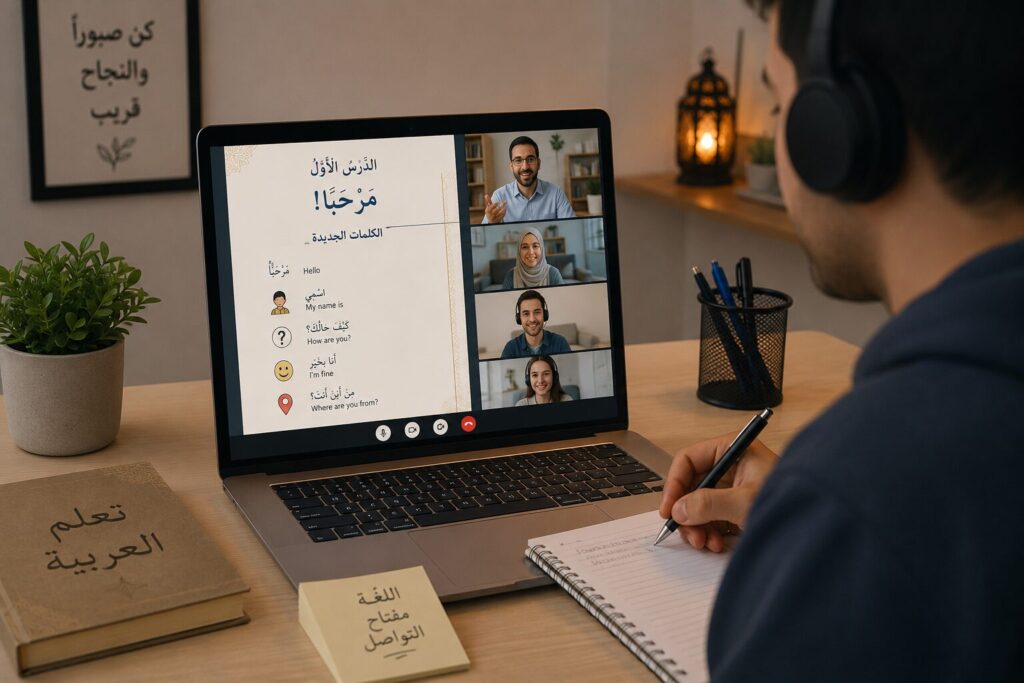
- Learn Modern Standard Arabic Online
- Why Learn Arabic with Al Qalam Institute?
- Conclusion
- Frequently Asked Questions
- 1. Learn the Modern Standard Arabic Alphabet
The Arabic alphabet is the first essential step for anyone who wants to learn Modern Standard Arabic.
Arabic has 28 letters and is written from right to left.
However, simply memorizing the names of the letters is not enough. Beginners also need to learn how each letter looks and sounds in different positions within a word.
For example, a letter can have different forms when it appears:
- By itself
- At the beginning of a word
- In the middle of a word
- At the end of a word
Learning these forms early makes reading Arabic much easier later.
- Why Arabic Letter Forms Matter
Many beginners try to move quickly into vocabulary and grammar without becoming comfortable with the alphabet.
This often creates reading problems later.
A better approach is to spend enough time recognizing Arabic letters, connecting them correctly, and producing their sounds accurately before moving to more advanced material.
If you are starting Arabic from zero, building a strong foundation in the Arabic alphabet can save you a great deal of difficulty later.
- Want to start learning Arabic from the beginning?
[Start Your Free Trial with Al Qalam Institute]
- 2. Master Short Vowels and Harakat
After learning the Arabic alphabet, the next important step is learning harakat, or short vowel marks.
The three basic short vowels are:
- Fatha: َ
- Kasra: ِ
- Damma: ُ
There are also other pronunciation marks that Arabic learners gradually become familiar with, including:
- Sukoon: ْ
- Shadda: ّ
- Tanween: ً ٍ ٌ
These marks help beginners understand how Arabic words are pronounced.
For example:
كَتَبَ
The vowel marks make it possible for a beginner to read the word correctly.
As learners become more advanced, they will encounter Arabic texts without vowel marks. At that stage, grammar, vocabulary, and context help them determine the correct pronunciation.
- Why Should Beginners Learn Harakat?
Skipping harakat can make Arabic reading much harder.
A learner may recognize the letters in a word but still struggle to pronounce the word correctly.
For this reason, beginners should practice:
- Recognizing the letters
- Recognizing the short vowels
- Combining letters and vowels
- Reading short words
- Reading fully vowelled sentences
This creates a strong foundation for Arabic reading.
- 3. Build Your Core Arabic Vocabulary
Once you are comfortable with the alphabet and basic vowel marks, begin building your Arabic vocabulary.
One of the most useful features of Arabic is its root system.
Many Arabic words are connected through three-letter roots.
For example, the root:
ك – ت – ب
is associated with writing.
From this root we can find related words such as:
- كَتَبَ — wrote
- كِتَاب — book
- كَاتِب — writer
- مَكْتَب — office
Another example is:
د – ر – س
which is connected to studying and learning:
- دَرَسَ — studied
- دَرْس — lesson
- مَدْرَسَة — school
- مُدَرِّس — teacher
Understanding these relationships helps learners see Arabic vocabulary as a connected system rather than thousands of unrelated words.
- Which Arabic Words Should Beginners Learn First?
Start with high-frequency words that you will encounter repeatedly.
- Pronouns
- أنا — I
- أنتَ — you
- هو — he
- هي — she
- نحن — we
- هم — they
- Question Words
- مَن — who
- ما — what
- أين — where
- متى — when
- كيف — how
- لماذا — why
- Common Words
- يوم — day
- وقت — time
- بيت — house
- عمل — work
- إنسان — person
The goal is not to memorize hundreds of random words at once.
Instead, learn vocabulary in meaningful contexts and use new words repeatedly.
- 4. Learn Common Arabic Verbs and Patterns
Verbs are another essential part of learning Modern Standard Arabic.
Arabic verbs change according to:
- Person
- Gender
- Number
- Tense
Beginners often try to memorize every conjugation separately.
A better approach is to understand the patterns behind Arabic verbs.
For example:
| Arabic Verb | Meaning |
|---|---|
| ذَهَبَ | to go / went |
| قَالَ | to say / said |
| أَخَذَ | to take / took |
| عَرَفَ | to know / knew |
| أَرَادَ | to want / wanted |
| رَأَى | to see / saw |
| جَاءَ | to come / came |
| فَعَلَ | to do / did |
Start with common verbs and gradually learn how they change in the past, present, and imperative forms.
- Learn Verbs in Sentences
Instead of learning:
ذَهَبَ = went
try learning it in context:
ذَهَبَ الطَّالِبُ إِلَى الْمَدْرَسَةِ.
“The student went to school.”
This allows you to learn vocabulary, grammar, and sentence structure at the same time.
- 5. Study Arabic Grammar Step by Step
Arabic grammar, or النحو, can seem complicated when beginners first encounter it.
The solution is not to avoid grammar completely.
Instead, learn grammar gradually and connect every rule to real examples.
Two important sentence structures to understand early are:
- Nominal Sentences — الجملة الاسمية
A nominal sentence generally begins with a noun.
For example:
الطَّالِبُ مُجْتَهِدٌ.
“The student is diligent.”
- Verbal Sentences — الجملة الفعلية
A verbal sentence begins with a verb.
For example:
كَتَبَ الطَّالِبُ الدَّرْسَ.
“The student wrote the lesson.”
As you progress, you can begin studying more advanced areas such as:
- Gender
- Singular and plural forms
- Pronouns
- Verb conjugation
- Prepositions
- Adjectives
- Possessive structures
- Case endings
- Nominal and verbal sentence structures
- Nahw and Sarf
The important thing is to study grammar progressively rather than trying to master everything at once.
- 6. Practice Useful Arabic Phrases in Context
Vocabulary is important, but learning complete phrases can help you communicate more naturally.
For example:
- Greetings and Formal Expressions
السَّلَامُ عَلَيْكُمْ
As-salamu alaykum
“Peace be upon you.”
وَعَلَيْكُمُ السَّلَامُ
Wa alaykum as-salam
“And peace be upon you.”
أَهْلًا وَسَهْلًا
Ahlan wa sahlan
“Welcome.”
كَيْفَ حَالُكَ؟
Kayfa haluk?
“How are you?”
أَنَا بِخَيْرٍ
Ana bikhayr.
“I am well.”
شُكْرًا جَزِيلًا
Shukran jazeelan.
“Thank you very much.”
مِنْ فَضْلِكَ
Min fadlik.
“Please.”
- Why Learn Phrases?
When you learn complete expressions, you begin to understand how Arabic words work together.
You also become more comfortable recognizing Arabic in real conversations, reading materials, and lessons.
- 7. Develop Arabic Reading Fluency
Reading Arabic is one of the most important skills to develop when learning MSA.
But reading fluently does not happen simply by memorizing the alphabet.
You need regular exposure to Arabic texts at the right level.
A useful progression is:
- Stage 1: Fully Vowelled Texts
Begin with short, simple texts that contain harakat.
Focus on:
- Correct pronunciation
- Letter recognition
- Word recognition
- Basic comprehension
- Stage 2: Partially Vowelled Texts
As your skills improve, begin reading texts with fewer vowel marks.
You will gradually use your vocabulary and grammar knowledge to understand how words should be pronounced.
- Stage 3: Unvowelled Arabic
Eventually, move toward authentic Arabic materials such as:
- News excerpts
- Articles
- Books
- Formal writing
- More advanced Arabic texts
The key is to choose material appropriate for your level.
- Practice Reading Regularly
Even 20–30 minutes of consistent daily practice can be more useful than studying for several hours once a week.
Consistency is one of the most important factors in language learning.
- 8. Improve Your Arabic Pronunciation
Arabic contains several sounds that can be difficult for non-native speakers.
Some examples include:
ص — ض — ط — ظ
and:
ع — ح — غ — ق
These sounds require learners to understand where and how the sound is produced.
For example, the Arabic letter ع does not have a direct equivalent in English.
Simply listening to recordings may not always be enough to correct pronunciation problems.
A qualified teacher can listen to your pronunciation and immediately explain what needs to change.
- How to Improve Arabic Pronunciation
Try this simple routine:
- Listen carefully to a native or qualified speaker.
- Repeat the word.
- Record yourself.
- Compare your pronunciation.
- Ask a teacher to correct difficult sounds.
- Repeat the corrected pronunciation.
With regular practice, difficult Arabic sounds become much more familiar.
- 9. Learn Modern Standard Arabic Online
Today, you can find thousands of Arabic videos, apps, books, and websites online.
These resources can be extremely useful.
However, self-study also has limitations.
When learning alone, it can be difficult to know:
- Whether your pronunciation is correct
- Which grammar topics you should study next
- Which mistakes you are repeating
- Whether the material matches your level
- How to stay consistent
- How to practice speaking with feedback
This is why structured online Arabic classes can make a major difference.
At Al Qalam Institute, students can learn Arabic online with structured lessons and personalized guidance based on their level and goals.
Whether your goal is to:
- Learn Arabic from zero
- Improve your Arabic reading
- Study Modern Standard Arabic
- Improve your speaking
- Learn Egyptian Arabic
- Understand Arabic texts
- Improve your grammar
- Learn Arabic for travel or daily life
A structured learning plan can help you make steady progress.
Ready to start learning Arabic?
- 10. Why Learn Arabic with Al Qalam Institute?
Learning Arabic is not only about memorizing vocabulary and grammar rules.
You need a learning path that connects the different parts of the language.
At Al Qalam Institute, our goal is to make Arabic learning structured, practical, and accessible for non-native speakers.
Our programs can help learners develop skills in areas such as:
- Arabic Language
Build your Arabic skills progressively through reading, vocabulary, grammar, and communication.
- Modern Standard Arabic
Develop a strong foundation in formal Arabic for reading, writing, comprehension, and communication.
- Egyptian Arabic
For learners who live in Egypt, plan to visit Egypt, or simply want to communicate naturally with Egyptians, learning Egyptian Arabic can be especially useful.
- Quran and Arabic
For Muslim learners, Arabic can also open the door to a deeper understanding of the language of the Quran.
- Islamic Studies
Arabic learning can be combined with Islamic studies according to the learner’s goals and level.
The most important thing is to choose the learning path that matches your personal goals.
- How Long Does It Take to Learn Modern Standard Arabic?
There is no single answer because every learner starts from a different level.
Your progress depends on factors such as:
- Your native language
- Previous experience with Arabic
- How often you study
- How much Arabic you hear
- How much you read
- Your speaking practice
- The quality of your learning materials
- Whether you receive regular feedback
A learner who studies for a short period every day may progress more consistently than someone who studies for several hours only once a week.
Instead of asking:
“How quickly can I become fluent?”
ask:
“What can I improve today?”
Small, consistent progress eventually creates significant results.
- A Simple Daily Plan for Learning Arabic
If you are a beginner, you can start with a simple daily routine.
- 20–30 Minutes a Day
5 minutes: Review vocabulary
5 minutes: Practice pronunciation
10 minutes: Read an Arabic text
5 minutes: Practice grammar or sentence formation
5 minutes: Listen and repeat
You can increase the time as your schedule allows.
The most important thing is to maintain consistency.
- Common Mistakes Arabic Learners Should Avoid
Many beginners make the same mistakes when learning Arabic.
- 1. Trying to Learn Everything at Once
Arabic contains a huge amount of vocabulary and grammar.
You do not need to learn everything immediately.
Focus on the next step.
- 2. Memorizing Words Without Context
Learning isolated words makes it harder to use them naturally.
Learn words inside phrases and sentences whenever possible.
- 3. Ignoring Pronunciation
Incorrect pronunciation can become a habit if it is not corrected early.
Practice difficult sounds from the beginning.
- 4. Studying Grammar Without Examples
Grammar rules become much easier when you see them used in real sentences.
- 5. Studying Irregularly
Studying for hours once in a while is not always as effective as consistent daily practice.
- 6. Being Afraid of Making Mistakes
Mistakes are part of learning.
The goal is not to speak perfectly from the first day.
The goal is to improve with every lesson.
- Conclusion
Learning Modern Standard Arabic is a long-term journey, but it does not have to be overwhelming.
The best approach is to build your skills step by step:
- Learn the Arabic alphabet.
- Master harakat and pronunciation.
- Build useful vocabulary.
- Understand Arabic roots and patterns.
- Learn common verbs.
- Study grammar progressively.
- Practice useful phrases.
- Read Arabic regularly.
- Listen and improve your pronunciation.
- Practice consistently with guidance.
With the right learning plan, Arabic becomes much more manageable.
At Al Qalam Institute, we help non-native Arabic learners build their skills through structured Arabic and Quran programs designed around their needs and goals.
Your Arabic journey can start today.
[Book Your Free Trial with Al Qalam Institute]
- Frequently Asked Questions About Learning Modern Standard Arabic
- Is Modern Standard Arabic difficult to learn?
Modern Standard Arabic can be challenging for beginners because it has a different writing system, pronunciation system, vocabulary, and grammar structure from English and many other languages.
However, learning Arabic step by step makes the process much more manageable.
The most important factors are consistency, appropriate learning materials, regular practice, and feedback from a qualified teacher.
- Should I learn Modern Standard Arabic or Egyptian Arabic?
It depends on your goals.
If you want to read formal Arabic, understand news and educational materials, or build a broad foundation in Arabic, Modern Standard Arabic is an excellent choice.
If your primary goal is everyday communication with people in Egypt, Egyptian Arabic may be more useful for conversation.
For learners living in Egypt, studying both can be especially valuable.
- Can I learn Modern Standard Arabic online?
Yes.
Online Arabic classes allow students to learn from qualified teachers without needing to attend a physical classroom.
The important thing is to choose a structured program that includes regular practice, feedback, and lessons appropriate for your level.
- What is the best way to learn Arabic for beginners?
A strong beginner’s path usually starts with:
- Arabic letters
- Letter sounds
- Harakat
- Reading simple words
- Basic vocabulary
- Common phrases
- Basic grammar
- Simple conversations
Trying to skip the foundations often creates problems later.
- How long does it take to learn Arabic?
The answer depends on your goals, starting level, study schedule, and previous language-learning experience.
Some learners may develop basic reading skills relatively quickly, while reaching conversational or advanced proficiency requires much more practice.
Consistency is more important than trying to learn everything quickly.
- Can I learn Arabic and Quran together?
Yes.
Arabic and Quran studies can complement each other, particularly for learners who want to understand Quranic vocabulary and Arabic structures more deeply.
At Al Qalam Institute, learners can explore Arabic and Quran learning according to their individual goals.
- Is Modern Standard Arabic the same as Quranic Arabic?
No.
Modern Standard Arabic and Quranic Arabic are closely related, but they are not identical.
Modern Standard Arabic is the modern formal variety used in contemporary communication, education, media, and writing.
Quranic Arabic refers to the language of the Quran and has its own linguistic and stylistic characteristics.
Studying MSA can give learners a useful foundation for understanding Arabic, while dedicated Quranic Arabic study can take that understanding further.
- Where can I learn Arabic online?
You can learn Arabic online through Al Qalam Institute, with programs designed for non-native Arabic learners.
You can begin by taking a free trial lesson and discussing your current level and learning goals with the institute.