Tajweed Institute: How to Learn the Quran with Correct Recitation
The Prophet ﷺ said:
“The one who is proficient in the recitation of the Quran will be with the noble and righteous scribes.”
Sahih Muslim 798
Learning to recite the Quran correctly is a beautiful journey, but it is also a skill that requires practice, patience, and proper guidance. Simply listening to Quran recitations or memorizing Tajweed rules is not always enough. Students need opportunities to practice their recitation and receive correction from someone who understands the details of Quranic pronunciation.
This is why many students choose to study with a Tajweed institute.
A structured Tajweed program can help you understand the rules of Quranic recitation, improve your pronunciation, identify mistakes, and gradually develop more confidence when reading the Quran.
Whether you are completely new to Quran reading, an adult looking to improve your recitation, or a parent searching for Quran and Tajweed lessons for your child, finding the right learning environment can make the journey much easier.
What Is a Tajweed Institute?
A Tajweed institute is an educational institution that provides structured lessons in Tajweed, the science of reciting the Quran correctly.
Tajweed teaches students how to pronounce each Arabic letter properly, where each letter comes from, and how different letters and sounds should be pronounced when they appear together in Quranic verses.
A good Tajweed program normally combines theoretical knowledge with practical recitation.
Students do not simply memorize definitions such as Ikhfa, Idgham, or Qalqalah. They also practice these rules while reading the Quran and receive feedback from their teacher.
This is especially important for non-Arabic speakers.
Someone may be able to recognize Arabic letters but still struggle with sounds that do not exist in their native language. For example, distinguishing between ح and ه, ع and ء, or ص and س can take time and repeated practice.
A qualified teacher can listen to these sounds and help the student correct them step by step.
Why Is Learning Tajweed Important?
Tajweed helps students develop accurate Quranic pronunciation and recitation.
Allah ﷻ says:
وَرَتِّلِ الْقُرْآنَ تَرْتِيلًا
“And recite the Quran with measured recitation.”
Quran 73:4
The goal of Tajweed is not simply to make a recitation sound beautiful. It helps the reader give each letter its correct pronunciation and apply the appropriate rules while reciting.
For beginners, this can provide a strong foundation from the very beginning.
For students who have already been reading the Quran for years, Tajweed lessons can also help identify pronunciation habits that may have developed over time.
Correcting Mistakes
One of the biggest advantages of learning with a teacher is immediate correction.
When studying alone, it is easy to repeat the same mistake without realizing it. A student may think that a particular letter sounds correct simply because it sounds natural to them.
A Tajweed teacher can listen carefully and explain what needs to change.
The teacher may correct:
- The position of the tongue
- The pronunciation of a letter
- The amount of Ghunnah
- The length of a Madd
- Heavy and light pronunciation
- Qalqalah
- Rules of Noon Sakinah and Tanween
- Rules of Meem Sakinah
- Appropriate stopping and starting
With regular practice, these corrections can gradually become natural habits.
What Do You Learn in a Tajweed Course?
A structured Tajweed course usually progresses from basic pronunciation to more advanced recitation rules.
The exact curriculum can vary between institutes, but several important areas are commonly included.
Makharij Al-Huruf
Makharij Al-Huruf (مَخَارِجُ الْحُرُوفِ) means the articulation points of the Arabic letters.
Students learn where each letter is produced in the mouth, throat, tongue, lips, or nasal passage.
This is one of the most important foundations of Tajweed because incorrect articulation can change the sound of a letter.
Students gradually learn how to position their speech organs correctly and produce each sound more accurately.
Sifat Al-Huruf
After learning the articulation points, students begin studying the characteristics of Arabic letters, known as Sifat Al-Huruf (صِفَاتُ الْحُرُوفِ).
These characteristics help explain how individual letters should sound.
Students may study concepts such as:
- Hams
- Jahr
- Shiddah
- Rikhawah
- Isti’la
- Istifal
- Qalqalah
Understanding these characteristics helps students distinguish between letters that may sound similar to beginners.
Noon Sakinah and Tanween
One of the major areas of Tajweed is the rules of Noon Sakinah and Tanween.
Students learn four main rules:
- Izhar
- Idgham
- Iqlab
- Ikhfa
The correct application depends on the letter that comes after Noon Sakinah or Tanween.
Meem Sakinah
Students also learn the rules related to Meem Sakinah.
These include:
- Ikhfa Shafawi
- Idgham Shafawi
- Izhar Shafawi
Practicing these rules while reading actual Quranic verses helps students understand how they work in real recitation.
Madd
Madd refers to elongation in Quranic recitation.
Students gradually learn the different types of Madd and how long each sound should be extended.
Learning Madd correctly is important because shortening or extending a sound incorrectly can affect the quality and accuracy of recitation.
Qalqalah
Qalqalah is the echoing or bouncing quality associated with specific letters when they occur under particular conditions.
The five Qalqalah letters are:
ق ط ب ج د
Students practice producing the appropriate sound without exaggerating it.
Tafkhim and Tarqiq
Students also learn when certain letters should be pronounced heavily or lightly.
This is particularly important when dealing with letters such as ر, ل, and the letters of Isti’la.
With regular practice, students become more comfortable recognizing these situations during recitation.
Why Is a Qualified Tajweed Teacher Important?
Tajweed is a practical subject.
You can read books about Tajweed and watch hundreds of videos, but eventually you need someone to listen to your recitation.
A qualified teacher can hear details that students may not notice themselves.
For example, a student might understand the definition of Ghunnah perfectly but still produce the sound incorrectly. Another student might know the rules of Qalqalah but apply them too strongly.
These are the kinds of issues that are much easier to address when the student recites directly to a teacher.
This is one reason personalized Quran and Tajweed lessons can be particularly useful.
Should You Learn Tajweed Online or In Person?
Both online and in-person learning can provide valuable opportunities for Quran education.
Traditional classroom learning allows students to study in a physical environment with their teacher and classmates.
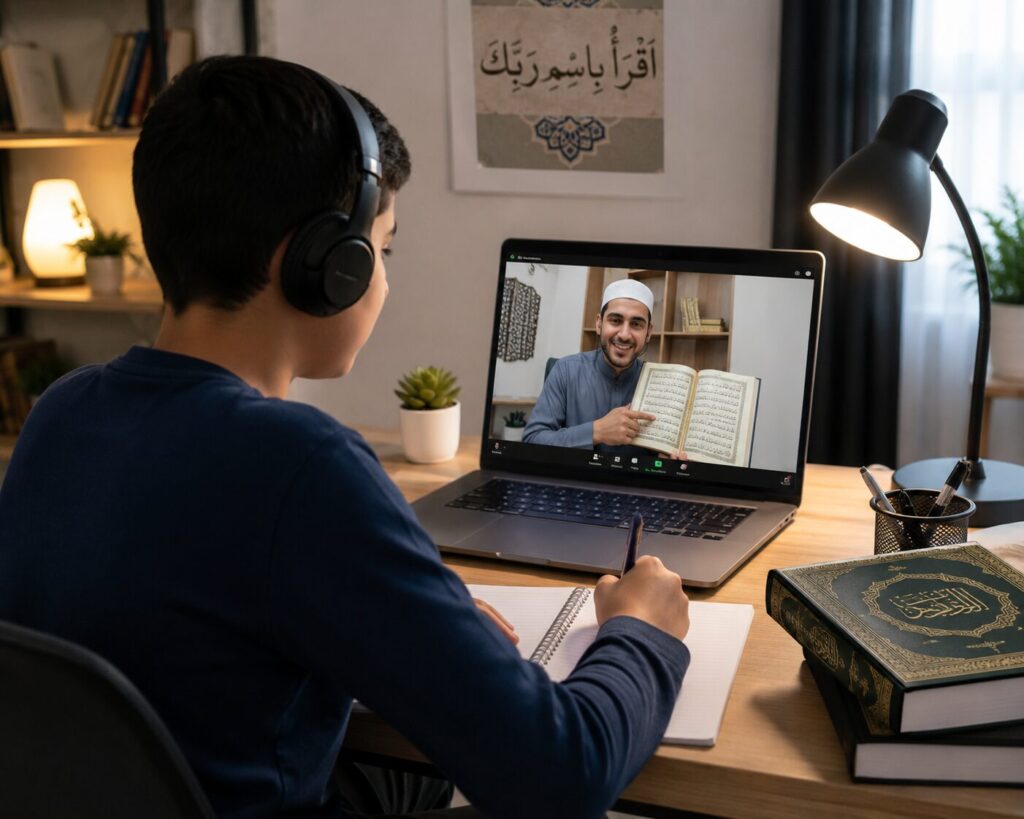
Online learning, on the other hand, gives students access to teachers without requiring them to travel.
For many students, online Tajweed classes offer several practical advantages.
They can:
- Study from home
- Choose a convenient schedule
- Receive individual attention
- Learn with a teacher regardless of location
- Continue lessons while traveling
- Build a consistent learning routine
The important thing is not simply whether the class is online or offline.
The quality of the teacher, the structure of the course, the amount of practical recitation, and the feedback provided to the student are all important factors.
How to Choose the Right Tajweed Institute
If you are searching for a Tajweed institute, it is worth asking a few questions before enrolling.
1. Who Are the Teachers?
Find out about the teachers’ Quranic education, Tajweed qualifications, teaching experience, and experience working with students at your level.
If you are interested in advanced Quran study or Ijazah, ask specifically about the teacher’s qualifications and Ijazah.
2. Is There a Structured Curriculum?
A good course should have a clear progression.
You should know what you are learning now, what comes next, and how your progress will be evaluated.
3. Will the Teacher Correct Your Recitation?
This is essential.
A Tajweed course should provide enough time for the student to actually recite and receive corrections.
4. Is the Program Suitable for Your Level?
A complete beginner needs a different starting point from an advanced Quran reader.
Look for a program that assesses your current level and places you in an appropriate learning path.
5. Is the Schedule Flexible?
For adults, parents, university students, and professionals, flexibility can make the difference between starting a course and maintaining it consistently.
Tajweed for Beginners
If you are completely new to Tajweed, there is no need to feel overwhelmed by the terminology.
You do not need to memorize every rule on your first day.
A beginner can start with the fundamentals:
- Recognizing Arabic letters
- Learning correct pronunciation
- Understanding articulation points
- Practicing basic Quran reading
- Learning foundational Tajweed rules
- Applying those rules during recitation
- Gradually improving fluency and accuracy
With consistent practice and guidance, students can progress step by step.
Tajweed for Children
Children can also benefit from structured Tajweed education.
However, teaching children requires an approach that is appropriate for their age and attention span.
Instead of presenting long theoretical explanations, lessons can combine:
- Repetition
- Listening
- Reading
- Pronunciation practice
- Simple explanations
- Encouragement
- Regular revision
The goal is to help children build correct Quran reading habits while developing a positive relationship with the Quran.
Tajweed for Adults
It is never too late to improve your Quran recitation.
Many adults begin Tajweed lessons after years of reading the Quran and discover that they have pronunciation habits they would like to correct.
Others may have never learned to read the Quran properly and want to start from the beginning.
A structured program can accommodate both situations.
The important thing is to begin at the level that matches your current ability rather than comparing yourself with other students.
Learn Tajweed with Al Qalam Institute
At Al Qalam Institute, we believe that learning the Quran should be structured, personal, and accessible to students from different backgrounds.
Our Quran programs are designed for learners at different levels, from beginners who are learning to read the Quran to students who want to improve their Tajweed and progress toward more advanced Quran studies.
Students can receive personalized instruction and practice their recitation directly with their teacher.
Our Quran programs include Quran Reading and Tajweed, Quran Memorization, and Quran Ijazah, along with Arabic and Islamic Studies programs.
Whether you are an adult looking to improve your own recitation or a parent searching for Quran lessons for your child, we can help you find a learning path that matches your level and goals.
Start Your Tajweed Journey
You do not need to wait until your Arabic is perfect.
You do not need to already know all the Tajweed rules.
And you do not need to be an advanced Quran reader.
You simply need to start.
With the right teacher, consistent practice, and a structured learning plan, you can gradually improve your pronunciation and Quran recitation.
Book your free trial lesson with Al Qalam Institute today and take the first step toward more confident and accurate Quran recitation.
WhatsApp: +20 109 020 5634
Website: https://alqalam-institute.com/
Frequently Asked Questions
Do I need to know Arabic before learning Tajweed?
No. You can begin learning Tajweed without being fluent in Arabic. Beginners can start with Arabic letters, pronunciation, and Quran reading before progressing to more detailed Tajweed rules.
Can I learn Tajweed online?
Yes. Live online Tajweed classes allow students to recite directly to a teacher and receive immediate feedback. This makes online learning a practical option for students who do not have access to a qualified teacher nearby.
How long does it take to learn Tajweed?
There is no fixed timeline. It depends on your starting level, lesson frequency, practice routine, and individual pronunciation needs. Consistent practice usually produces better progress than studying occasionally.
Can children learn Tajweed?
Yes. Children can learn Tajweed through age-appropriate Quran lessons that combine reading, repetition, pronunciation practice, and regular revision.
Can adults learn Tajweed?
Absolutely. Adults can start from the beginning or join at a higher level depending on their existing Quran reading ability.
Do I need an Ijazah to learn Tajweed?
No. An Ijazah is not required simply to begin learning Tajweed. It is associated with more advanced Quranic study and certification. Students who are interested in pursuing Ijazah should study with appropriately qualified teachers and follow a structured pathway.
What is the difference between Quran reading and Tajweed?
Quran reading refers to reading and reciting the Quran, while Tajweed is the system of rules and pronunciation principles that helps the reader recite the Quran accurately.
Is one-to-one Tajweed learning better for beginners?
One-to-one lessons give the teacher more opportunity to listen to the student’s recitation and address individual pronunciation issues. This can be particularly useful for beginners who are still developing their foundational reading skills.
Ready to improve your Quran recitation?
Start learning Tajweed with Al Qalam Institute.